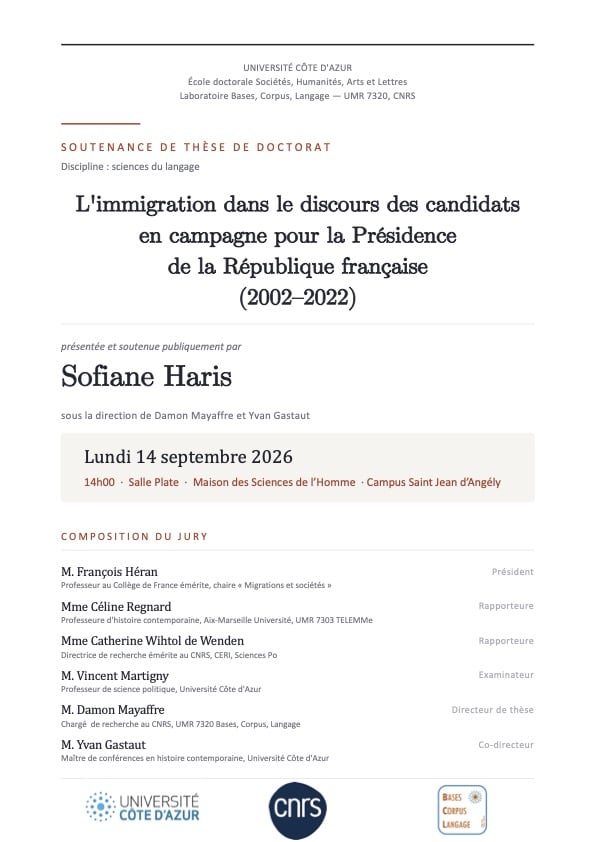
14 septembre 2026 – 14H – Salle Plate MSHS Sud-Est – Campus Saint-Jean-d’Angély 3 – Nice
Résumé
Inscrite au croisement de l’histoire et des humanités numériques, cette thèse analyse la fabrication des thématiques migratoires et identitaires dans les discours des campagnes présidentielles françaises depuis 2002. Fondée sur un corpus de prises de parole de candidats et candidates, l’analyse retrace l’intégration de l’immigration dans un lexique politique structuré configurant les représentations de l’altérité. L’orientation privilégie le registre discursif plutôt que les approches démographiques ou juridiques, et mobilise l’analyse textuelle outillée et l’apprentissage automatique pour quantifier régularités lexicales, cartographier hiérarchies thématiques, modéliser cooccurrences et détecter déplacements sémantiques. Le cadre comparatif confronte familles partisanes et trajectoires individuelles, avec attention aux cadrages sécurité, laïcité, identité nationale et appel humanitaire. L’apport principal réside dans la formalisation d’indicateurs reproductibles des dynamiques de cadrage et dans l’évaluation empirique des médiations opérées par le langage politique entre migration et identité au sein de la compétition électorale.
Mots-clés : immigration, discours politique, logométrie, intelligence artificielle, campagne électorale
Abstract
Situated at the intersection of history and the digital humanities, this dissertation examines the construction of migration- and identity-related themes in French presidential campaign discourse since 2002. Drawing on a corpus of speeches and public statements by presidential candidates, the analysis traces the incorporation of immigration into a structured political lexicon that shapes representations of otherness. Rather than adopting a demographic or legal approach, the dissertation focuses on discourse, using computational text analysis and machine learning to quantify lexical regularities, map thematic hierarchies, model co-occurrences, and detect semantic shifts. Its comparative framework brings together partisan families and individual trajectories, with particular attention to frames of security, secularism, national identity, and humanitarian appeal. The main contribution of the dissertation lies in the formalisation of reproducible indicators of framing dynamics and in the empirical assessment of the ways in which political language mediates the relationship between migration and identity within electoral competition.
Keywords: immigration, political discourse, logometry, machine learning, electoral campaign